Blog

Private markets and the future of viewability metrics

Some are already hailing private marketplaces as the “future of programmatic,” while others are lamenting their growing pains. There are “big changes” coming in the world of ad fraud. This viewability stuff needs to get sorted out, because there are some killer metrics waiting.

Here are a few highlights from some of the industry news we came across this week.

  • The Private Future Of Programmatic (MediaPost) – Programmatic advertising is continuing to scoop big-time dollars across an ever-growing landscape, and those dollars are expected to nearly double in the next five years. Private exchanges are being called the future of programmatic strategy. This is because that type of buying more directly resembles the the direct buys of old. You know, the ones advertisers are used to and more comfortable with. But, that being said …
  • Behind The Velvet Rope: Private Marketplaces Suffer Growing Pains (AdExchanger) – Private marketplaces have yet to live up to their potential as a programmatic access-point to premium inventory, and are being held back by under-developed technology. However, growth (and maturation) is expected as interest is there on both the buy and sell sides. Even so, there are still quite a few hurdles that private marketplaces must clear before they're the go-to solution for anyone.
  • It's About to Get Harder to Claim Ignorance on Ad Fraud (AdAge) – IAB's EVP Mike Zaneis admits that it's likely that publishers are neither “knowingly” buying or selling fraudulent traffic, but that the shoulder-shrugging will no longer be tolerated and the “everyone else is doing it” excuse just isn't going to cut it anymore. “Big changes are coming,” he says.
  • Navigating brand safety and ad fraud threats in the programmatic landscape (iMedia Connection) – AnyClip Media CTO Alex Liverant writes about how transparency should be the target of the ad tech industry. Viewable impressions and limiting ad fraud need to be the key pieces of the industry's foundation: “Viewable ads, targeted to engaged consumers, should be the basis of this industry and its future.”
  • It's Time To Move Beyond Viewability: Better Metrics Await (AdExchanger) – Much of the discussion surrounding the “viewability” topic centers around setting the standard — how many pixels for how many seconds? — but this article takes a look at what new metrics can be used to to measure the old-school goals of reach and relevance. “The real work is to tie new metrics back to these,” says Grapeshot SVP of Product Marketing Chris Stark (no relation to Tony … probably).

By |October 10th, 2014|Advertising Technology|0 Comments

AdTech Is Alive and Well: I’ll Have the Full Stack, Please

Reading The Information's piece on Facebook's reported re-introduction of the Atlas ad-serving technology , I wondered – Does the market really need six or more full stack adtech solutions? Google is the undisputed leader in the field – it's spent…

By |October 10th, 2014|Advertising Technology|0 Comments

Viewability and growth major parts of ad tech scene right now

Major talking points this week involved the continued uncertainty around the transition to a viewability standard, the absolute certainty around the growth in spending expected across the programmatic landscape, and what publishers are going to have to be ready for to be successful going forward.

  • Outside Voices: Online Ad Viewability Not Ready For Prime-Time (Wall Street Journal) – Meanwhile, Ziff Davis CEO Vivek Shah wants to make sure that the steps to move to viewability aren't taken in haste. Click through to see what Shah sees as standing in the way of the transition to what he calls a “goal which we need to remember is without precedent in the entire media landscape.”
  • Programmatic: A Rising Tide (AdExchanger) – Find out what Rare Crowds' CEO Eric Picard sees as the future of programmatic, and what publishers will need to be prepared for going forward.
  • How Tribune Publishing is evolving its programmatic approach (Digiday) – New CEO Jack Griffin is pushing to increase the publishing company's dependence on digital revenue, and programmatic selling is a major part of that concept. Programmatic is leading to sales changes and even new business relationships for the publicly-traded newspaper company.

By |October 3rd, 2014|Advertising Technology|0 Comments

Experiment: We Removed a Major Website from Google Search, for Science!

Posted by Cyrus-Shepard

The folks at Groupon surprised us earlier this summer when they reported the results of an experiment that showed that up to 60% of direct traffic is organic.

In order to accomplish this, Groupon de-indexed their site, effectively removing themselves from Google search results. That's crazy talk!

Of course, we knew we had to try this ourselves.

We rolled up our sleeves and chose to de-index Followerwonk, both for its consistent Google traffic and its good analytics setup—that way we could properly measure everything. We were also confident we could quickly bring the site back into Google's results, which minimized the business risks.

(We discussed de-indexing our main site moz.com, but... no soup for you!)

We wanted to measure and test several things:

  1. How quickly will Google remove a site from its index?
  2. How much of our organic traffic is actually attributed as direct traffic?
  3. How quickly can you bring a site back into search results using the URL removal tool?

Here's what happened.

How to completely remove a site from Google

The fastest, simplest, and most direct method to completely remove an entire site from Google search results is by using the URL removal tool.

CAUTION: Removing any URLs from a search index is potentially very dangerous, and should be taken very seriously. Do not try this at home; you will not pass go, and will not collect $200!

After submitting the request, Followerwonk URLs started disappearing from Google search results in 2-3 hours.

The information needs to propagate across different data centers across the globe, so the effect can be delayed in areas. In fact, for the entire duration of the test, organic Google traffic continued to trickle in and never dropped to zero.

The effect on direct vs. organic traffic

In the Groupon experiment, they found that when they lost organic traffic, they actually lost a bunch of direct traffic as well. The Groupon conclusion was that a large amount of their direct traffic was actually organic—up to 60% on "long URLs".

At first glance, the overall amount of direct traffic to Followerwonk didn't change significantly, even when organic traffic dropped.

In fact, we could find no discrepancy in direct traffic outside the expected range.

I ran this by our contacts at Groupon, who said this wasn't totally unexpected. You see, in their experiment they saw the biggest drop in direct traffic on long URLs, defined as a URL that is at least as long enough to be in a subfolder, like http://followerwonk.com/bio/?q=content+marketer.

For Followerwonk, the vast majority of traffic goes to the homepage and a handful of other URLs. This means we didn't have a statistically significant sample size of long URLs to judge the effect. For the long URLs we were able to measure, the results were nebulous.

Conclusion: While we can't confirm the Groupon results with our outcome, we can't discount them either.

It's quite likely that a portion of your organic traffic is attributed as direct. This is because of different browsers, operating systems and user privacy settings can potentially block referral information from reaching your website.

Bringing your site back from death

After waiting 2 hours, we deleted the request. Within a few hours all traffic returned to normal. Whew!

Does Google need to recrawl the pages?

If the time period is short enough, and you used the URL removal tool, apparently not.

In the case of Followerwonk, Google removed over 300,000 URLs from its search results, and made them all reappear in mere hours. This suggests that the domain wasn't completely removed from Google's index, but only "masked" from appearing for a short period of time.

What about longer periods of de-indexation?

In both the Groupon and Followerwonk experiments, the sites were only de-indexed for a short period of time, and bounced back quickly.

We wanted to find out what would happen if you de-indexed a site for a longer period, like two and a half days?

I couldn't convince the team to remove any of our sites from Google search results for a few days, so I choose a smaller personal site that I often subject to merciless SEO experiments.

In this case, I de-indexed the site and didn't remove the request until three days later. Even with this longer period, all URLs returned within just a few hours of cancelling the URL removal request.

In the chart below, we revoked the URL removal request on Friday the 25th. The next two days were Saturday and Sunday, both lower traffic days.

Test #2: De-index a personal site for 3 days

Likely, the URLs were still in Google's index, so we didn't have to wait for them to be recrawled.

Here's another shot of organic traffic before and after the second experiment.

For longer removal periods, a few weeks for example, I speculate Google might drop these semi-permanently from the index and re-inclusion would comprise a much longer time period.

What we learned

  1. While a portion of your organic traffic may be attributed as direct (due to browsers, privacy settings, etc) in our case the effect on direct traffic was negligible.
  2. If you accidentally de-index your site using Google Webmaster Tools, in most cases you can quickly bring it back to life by deleting the request.
  3. Reinclusion happens quickly even after we removed a site for over 2 days. Longer than this, the result is unknown, and you could have problems getting all the pages of your site indexed again.

Further reading

Moz community member Adina Toma wrote an excellent YouMoz post on the re-inclusion process using the same technique, with some excellent tips for other, more extreme situations.

Big thanks to Peter Bray for volunteering Followerwonk for testing. You are a brave man!


Sign up for The Moz Top 10, a semimonthly mailer updating you on the top ten hottest pieces of SEO news, tips, and rad links uncovered by the Moz team. Think of it as your exclusive digest of stuff you don't have time to hunt down but want to read!

By |August 12th, 2014|MOZ|1 Comment

Beyond Search: Unifying PPC and SEO on the Display Network

ga-remarketing-list-types.PNG

Posted by anthonycoraggio

PPC and SEO go better together. By playing both sides of the coin, it's possible to make more connections and achieve greater success in your online marketing than with either alone.

That the data found in search query reporting within AdWords can be a valuable source of information in keyword research is well known. Managing the interaction effects of sharing the SERPs and capturing reinforcing real estate on the page is of course important. Smart marketers will use paid search to test landing pages and drive traffic to support experiments on the site itself. Harmony between paid and organic search is a defining feature of well executed search engine marketing.

Unfortunately, that's where the game all too often stops, leaving a world of possibilities for research and synergy waiting beyond the SERPs on the Google Display Network. Today I want to give you a couple techniques to kick your paid/organic collaboration back into gear and get more mileage from combining efforts across the disciplines.

Using the display network

If you're not familiar with it already, the GDN is essentially the other side of AdSense, offering the ability to run banner, rich media, and even video ads across the network from AdWords or Doubleclick. There are two overarching methods of targeting these ads: by context/content, and by using remarketing lists. Regardless of your chosen method, ads here are about as cheap as you can find (often under a $1 CPC), making them a prime tool for exploratory research and supporting actions.

Contextual and content-based targeting offers some simple and intuitive ways to extend existing methods of PPC and SEO interaction. By selecting relevant topics, key phrases, or even particular sites, you can place ads in the wild to test the real world resonance of taglines and imagery with people consuming content relevant to yours.

You can also take a more coordinated approach during a content marketing campaign using the same type of targeting. Enter a unique phrase from any placements you earn on pages using AdSense as a keyword target, and you can back up any article or blog post with a powerful piece of screen real estate and a call to action that is fully under your control. This approach mirrors the tactic of using paid search ads to better control organic results, and offers a direct route to conversion that usually would not otherwise exist in this environment.

Research with remarketing

Remarketing on AdWords is a powerful tool to drive conversions, but it also produces some very interesting and frequently neglected data in the proces: Your reports will tell you which other sites and pages your targeted audience visits once your ads display there. You will, of course, be restricted here to sites running AdSense or DoubleClick inventory, but this still adds up to over 2 million potential pages!

If your firm is already running remarketing, you'll be able to draw some insights from your existing data, but if you have a specific audience in mind, you may want to create a new list anyway. While it is possible to create basic remarketing lists natively in AdWords, I recommend using Google Analytics to take advantage of the advanced segmentation capabilities of the platform. Before beginning, you'll need to ensure that your AdWords account is linked and your tracking code is updated.

Creating your remarketing list

First, define who exactly the users you're interested in are. You're going to have to operationalize this definition based on the information available in GA/UA, so be concrete about it. We might, for example, want to look after users who have made multiple visits within the past two weeks to peruse our resources without completing any transactions. Where else are they bouncing off to instead of closing the deal with us?

If you've never built a remarketing list before, pop into the creation interface in GA through Admin > Remarketing > Audiences. Hit the big red '+ Audience' button to get started. You're first presented with a selection of list types:

The first three options are the simplest and least customizable, so they won't be able to parse out our theoretical non-transactors, but can be handy for this application nonetheless. The Smart List option is a relatively new and interesting option. Essentially, this will create a list based on Google's best algorithmic guess at which of your users are most likely to convert upon return to your site. The 'black box' element to Smart Lists makes it less precise as a tool here, but it's simple to test and see what it turns up.

The next three are relatively self explanatory; you can gather all users, all users to a given page, or all that have completed a conversion goal. Where it gets truly interesting is when you create your own list using segments. All the might of GA opens up here for you to apply criteria for demographics, technology/source, behavior, and even advanced conditions and sequences. Very handily, you can also import any existing segments you've created for other purposes.

In this figure, we're simply translating the example from above into some criteria that should fairly accurately pick out the individuals in which we are interested.

Setting up and going live

When you've put your list together, simply save it and hop back over to AdWords. Once it counts at least 100 users in its target audience, Google will let you show ads using it as targeting criteria. To set up the ad group, there are a few key considerations to bear in mind:

  1. You can further narrow your sample using AdWords' other targeting options, which can be very handy. For example, want to know only what sites your users visit within a certain subject category? Plug in topic targeting. I won't jump down the rabbit hole of possibilities here, but I encourage you to think creatively in using this capability.
  2. You'll of course need fill the group with some actual ads for it to work. If you can't get some applicable banner ads, you can create some simple text ads. We might be focusing on the research data to be had in this particular group, but remember that users are still going to see and potentially click these ads, so make sure you use relevant copy and direct them to an appropriate landing page.
  3. To hone down on unique and useful discoveries, consider setting some of the big generic inventory sources like YouTube as negative targets.
  4. Finally, set a reasonable CPC bid to ensure your ads show. $0.75 to $1.00 should be sufficient; if your ads aren't turning up many impressions with a decent sized list, push the number up a bit.

To check on the list size and status, you can find it in Shared Library > Audiences or back in GA. Once everything is in place, set your ads live and start pulling in some data!

Getting the data

You won't get your numbers back overnight, but over time you will collect a list of the websites your remarketed ads show on: all the pages across the vast Google Display Network that your users visit. To find it, enter AdWords and select the ad group you set up. Click the "Display Network" and "Placements" tabs:

placement-data-tabs.PNG

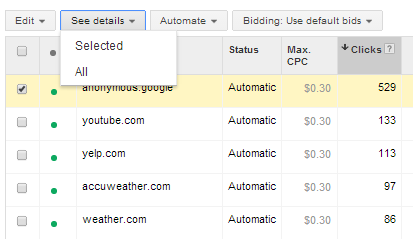
You'll see a grid showing the domain level placements your remarketing lists have shown on, with the opportunity to customize the columns of data included. You can sift through the data on a more granular level by clicking "see details;" this will provide you with page level data for the listed domains. You're likely to see a chunk of anonymized visits; there is a workaround to track down the pages in here, but be advised it will take a fair amount of extra effort.

plaecments-see-details.png

Tada! There you are—a lovely cross section of your target segment's online activities. Bear in mind you can use this approach with contextual, topic, or interest targeting that produces automatic placements as well.

Depending on your needs, there are of course myriad ways to make use of display advertising tools in sync with organic marketing. Have you come up with any creative methods or intriguing results? Let us know in the comments!


Sign up for The Moz Top 10, a semimonthly mailer updating you on the top ten hottest pieces of SEO news, tips, and rad links uncovered by the Moz team. Think of it as your exclusive digest of stuff you don't have time to hunt down but want to read!

By |August 11th, 2014|MOZ|2 Comments